Stylish depth with ceramic tile design
This past week, we started looking at this very interesting three dimensional tile. One of the big differences between regular, typical, and traditional flat tile and this type of three dimensional tile is that this tile has a glaze application on five sides, in some cases. The implications are that the firing process is different. Instead of being able to just set the tile on a flat surface for glazing and firing, this type of tile has to be fired in an area that allows for circulation of heated air around six sides, not just with predominant focus on the top and bottom.
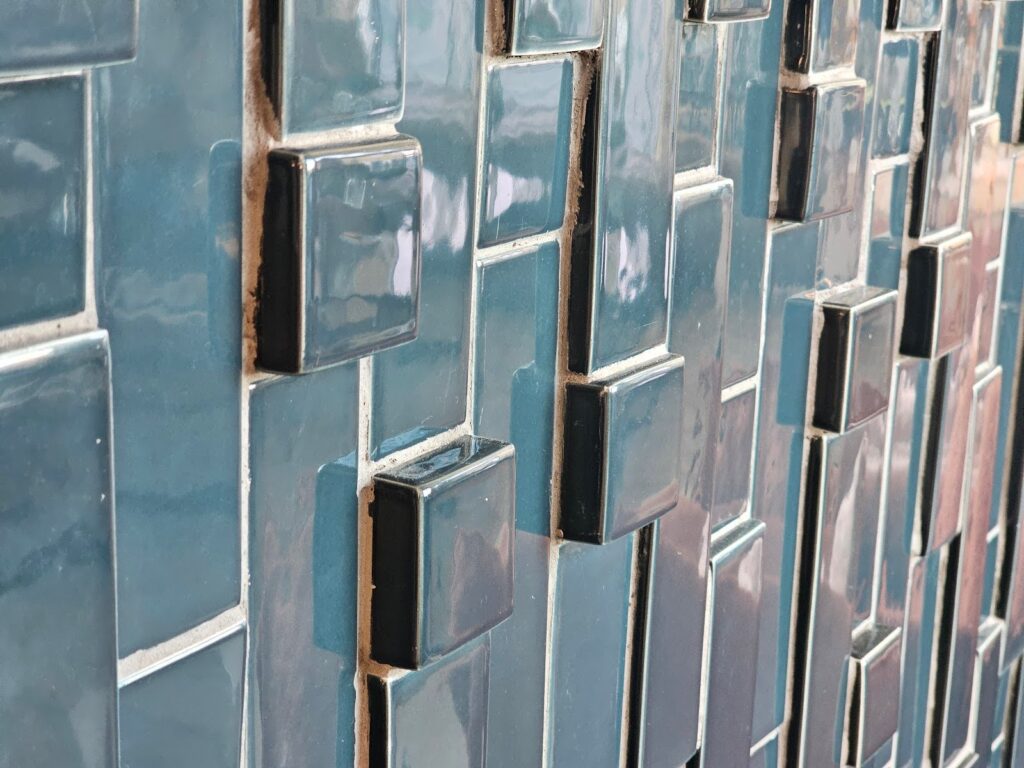
It also might go without saying, but this tile cannot be used as a floor tile, it can only be used as a wall tile. That might seem very obvious, but it’s a distinction that is important. Many different types of tiles can be used both for floors and walls, and in design, that matters. Obviously if you were to put a tile like this on the floor it would make the walking surface very uneven.
Also, it seems that the protruding or higher portions of the tile would be at risk of breakage and damage from even typical for traffic. Plus obviously, the lippage and variation in the horizontal surface would be a significant trip hazard. All of these characteristics are completely obvious, but we mentioned them to discuss some of the characteristics that are important or relevant for walking surface tiles versus wall tiles.

Often a client or designer is charged with the responsibility of making sure the wall tile and floor surface match or complement one another. In some cases when a tile can be used for both floors and walls, there are circumstances where a singular or sole type of tile is useful to be installed in both applications. Sometimes, depending on the application, a wall and floor of the same tile might even work together from a visual design perspective, without looking excessively redundant or mundane.
This can be helpful because the alternative, in some cases, of having multiple different types of finishes that compliment, but not necessarily compliment well, might look like a clash of styles and might create a visual aesthetic that is busy and conflicting.

Another particular interesting detail about this installation is that they used a steel angle iron as a corner. Often with different types of tiles, the corner itself needs to be terminated with a unrelated or different material. The tile itself can meet against another tile at a corner, but only if the particular dimension of the wall happens to run perfectly coincident with the incremental size of the tiles.
In other words, if you were to have a wall that was 40 in width, but we’re using tile that were 12 in width, you would need 3.33 tiles, installed in a horizontal course, to achieve the width of the wall. The number 3.33 is not a compete integer. You have a leftover four inches, after subtracting a full integer of 3. That leftover 4 inches, in most cases, will be achieved or filled with a 1/3 portion of a tile.
All of that amounts to or means that the wall, in that case, requires a partial tile which must be cut from a full tile. If a cut tile is installed at the outer edge of a corner, you will see the cut edge. It doesn’t look good. In almost all cases of tile installation, at an outside corner, if you can see a visually exposed portion of a cut tile you can see the difference of the earthen substrate tile material and the porcelain or ceramic glaze material.
That difference doesn’t look good. When the cut earthen material of the porcelain or ceramic is exposed, it looks like a incomplete work. These tiles are not intended to show the underside or the cut edges. Corner beads can be used to cover those cut edges. Corner beads, for this purpose, are available in a variety of different shapes and sizes.
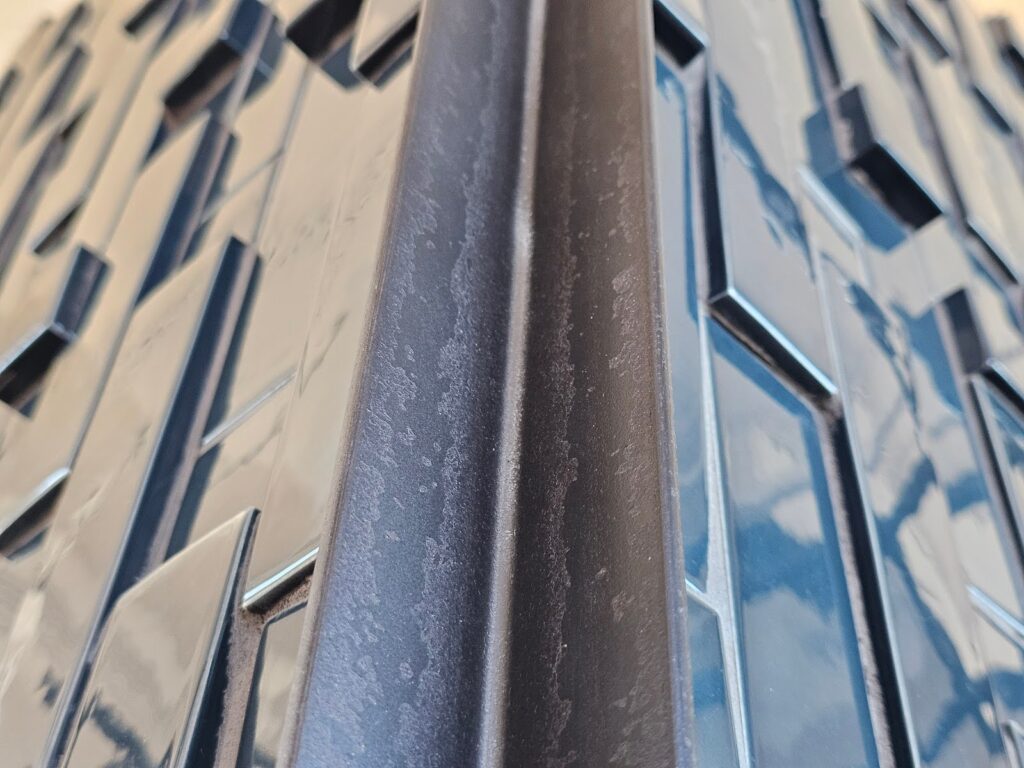
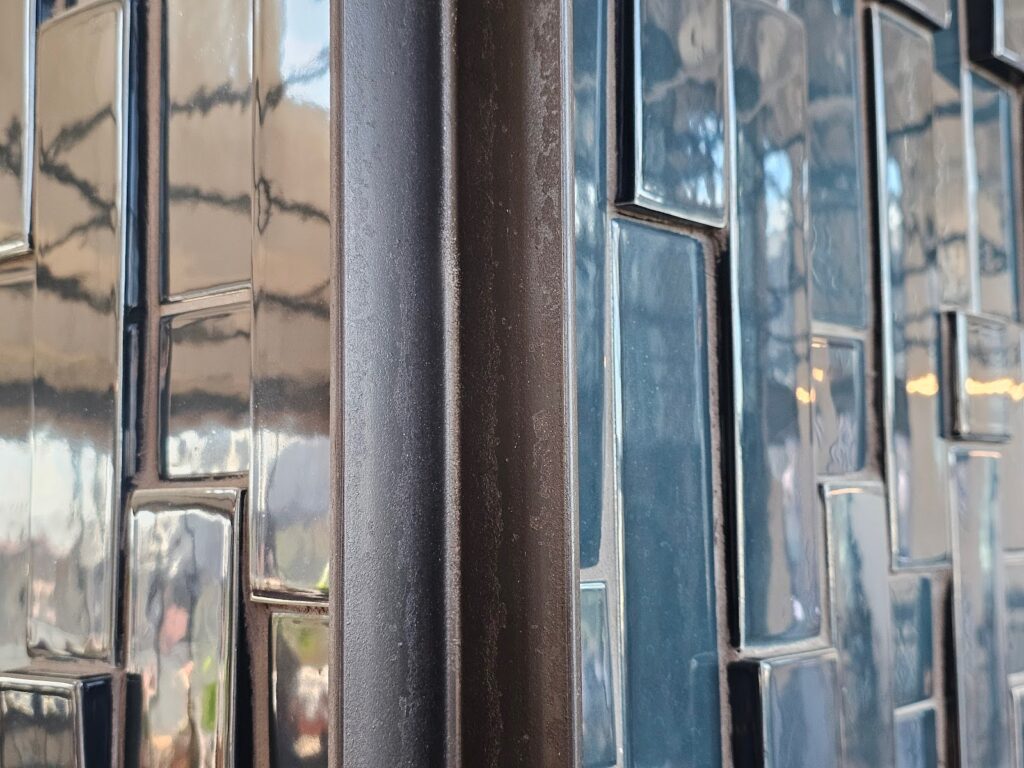
Here though, they did something very interesting. Instead of using a purpose made corner bead, they used a portion of a length of steel angle. This happens to be blue steel which is an industrial material used mostly for concealed structural elements, in most cases. Normally the factory finish, is at least painted when left exposed. Here though they’ve applied a clear sealer and left that factory finish of the steel exposed. It creates an industrial aesthetic which the designer thought would pair well with this blue tile.
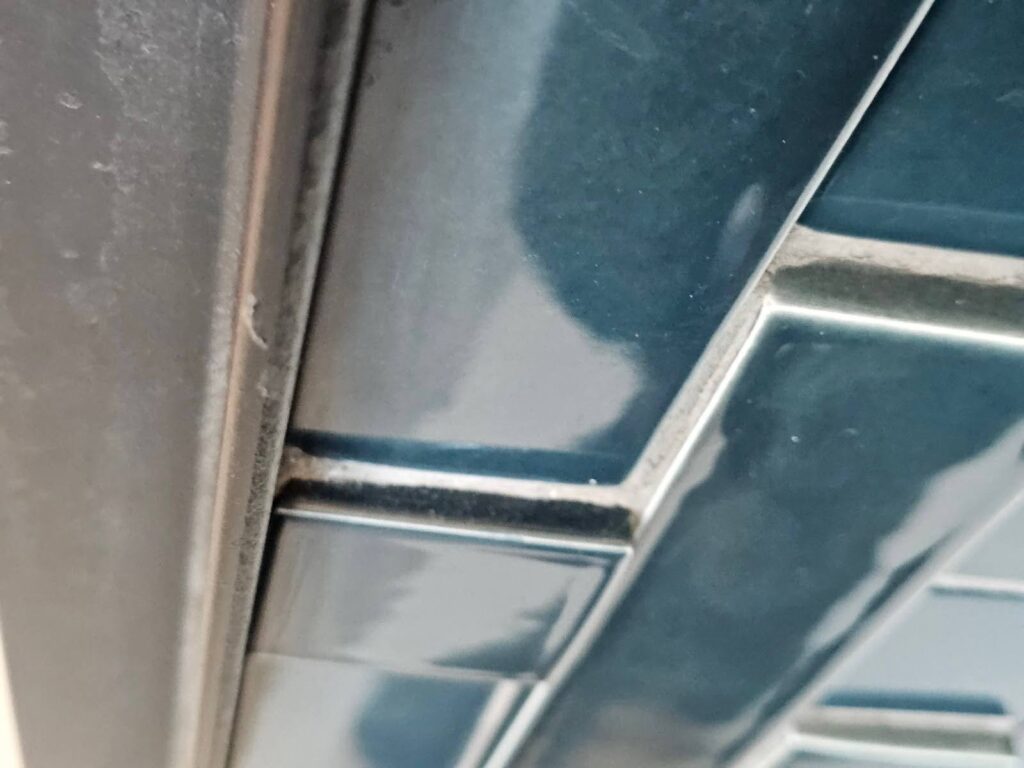
Unlike most corner beads, this angle iron also protrudes from the planar surfaces of the tile wall. For better or worse, that’s the chosen or intended installation aesthetic. It’s something you don’t see often, and the designer, in this case, may have thought that it would be visually impactful to build something so unique.
Dupont Kitchen & Bath Can Help
As dedicated and local DC metropolitan kitchen and bath builders and installers, we pride ourselves on turning your visions into reality. Your kitchen and bathrooms can reflect your unique style and be designed with personalized aesthetics. It can be a process from creative designs to the realization of your dream space. Specializing in kitchen and bath construction, we bring expertise and skills to every project. If you’re contemplating a renovation, upgrade, or modernization in the local market, we’re happy to be your team. Consult with us, and we can start together on a path to redefine and elevate your DC living experience.
You can visit our company website at https://dupontkitchenbathdc.com/
Here at our website you will find a simple and convenient web form that you can fill to contact us quickly.