Bianca Montana Tile Texture Replica

Bianca Montana Tile Texture Replica for Luxury Bathroom Design

Today we’re looking at a bathroom floor installation. This is a relatively typical type of tile, but it’s a duplicate or a replica of a Bianca Montana stone.  Its not actual stone though, it’s actually porcelain or ceramic.  This tile is a beige earth tone color, and the tile shows some of the effects In the texture that you expect to see in a natural stone. Many people don’t actually identify the difference between natural stone and ceramic tile, they just assume ceramic is natural if it’s made to look natural. In that particular way it’s a bit like art, it can trick the eye, in some cases.
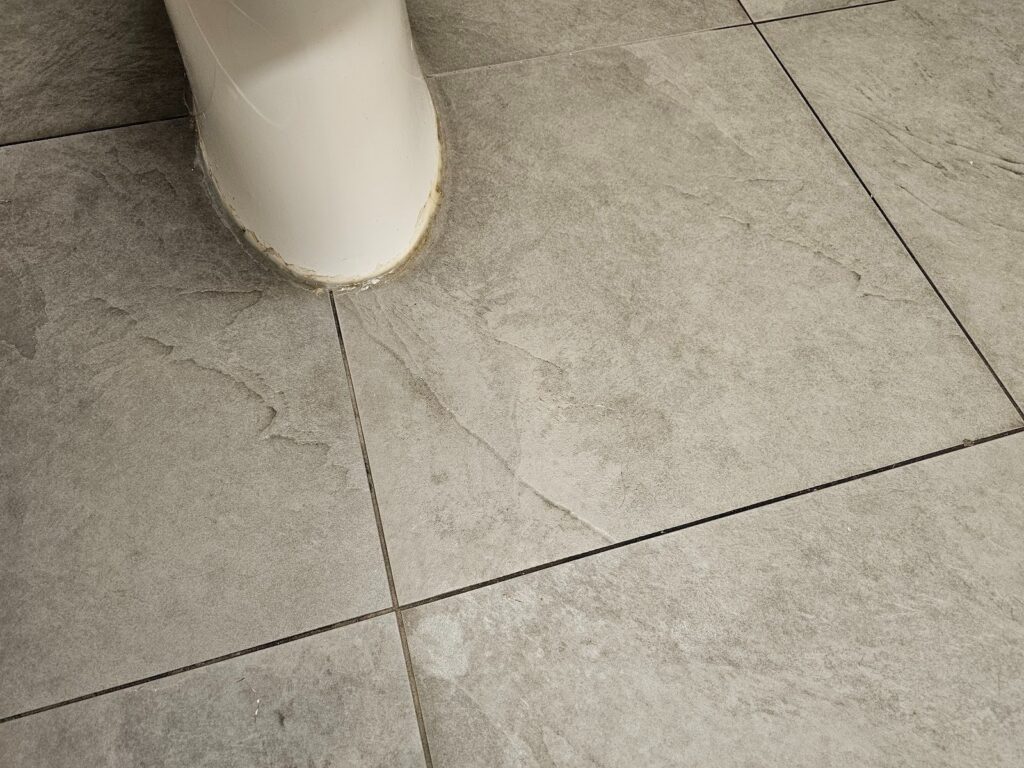
Bianca Montana Tile Texture Replica

The installer used a grout line that is a medium brown color, but in some cases the grout line has darkened with dirt.  Also, as a side note, you may notice that in the picture above, the caulking between the floor and the toilet is really dirty. Here they used a white caulking. Whenever you’re sealing a toilet to a floor, and there’s two elements that may have different colors and you can pick to use either of the two colors to make it match pretty well.

If you instead pick a third color that’s completely different from the color of the toilet and the color of the floor, it will really stand out and generally not look very good.

Masking tape can be applied around the base of the toilet and if you have a floor with an earthtone color, you can generally find a beige tile caulking color that will blend in pretty well.  It’s important to consider the texture. Here, the ceramic tile has a faux texture that will make it a little bit harder to apply a masking and release it in a way that looks like the line between the transition of these colors is consistent.

If you look at the difference or the variation across the tile you can see that the faux texture of the top has lines that are pronounced and very dark. To a degree, some of that color variation may be part of the faux design, but another element here is that the floor is just dirty. These tile floors are not completely maintenance-free. They can last for many years with relatively low maintenance, but they do require cleaning of the grout, continual resealing of the grout, and general upkeep.

The caulking between transitions such as the floor to the toilet have to be removed and replaced on a timeline much shorter than the expected life of the tile system itself. Essentially, that caulking will deteriorate, naturally, even when well cared for, at a faster rate than the tile. The tile may last as long as 50 years if very well cared for and used gently. The caulking may only last as little as a few years or as much as 10 years if it’s treated very gently.
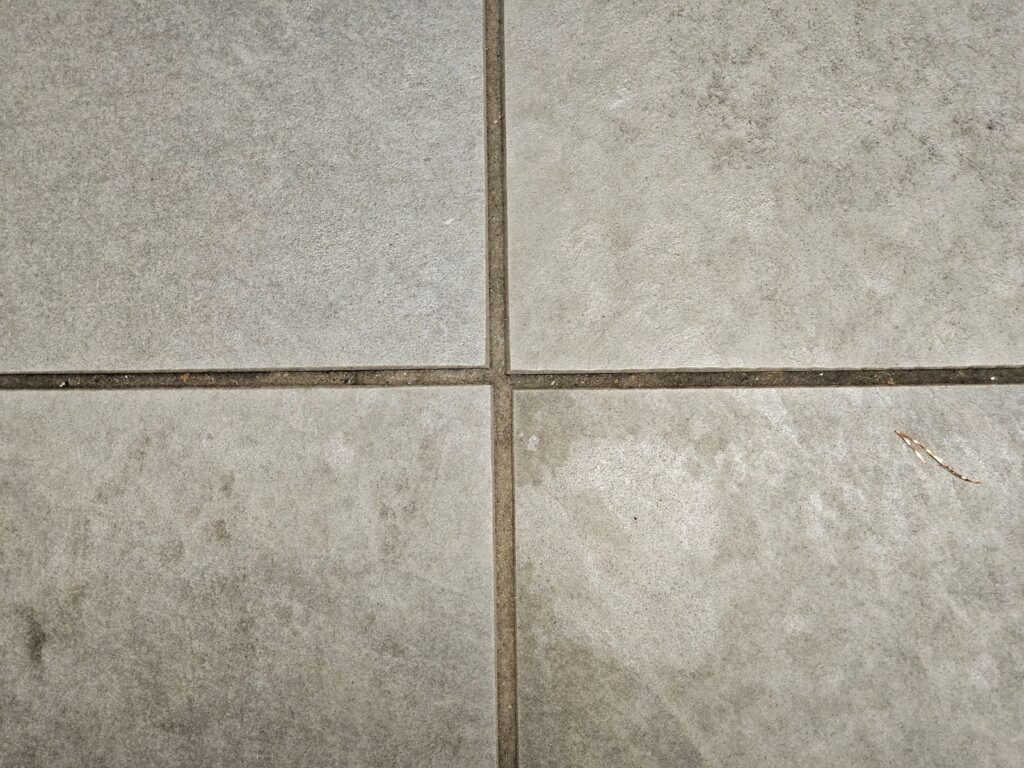
the ceramic tile has a faux texture

If you look closely at the joint in the crossroads of the grout line between these four different tiles, it’s like a four-way intersection. You may notice there’s a little bit of an improper or incorrect offset. It looks a little wonky, it’s out of alignment. It might not stand out to everybody and most people might be able to walk right past it without ever noticing it, but if you’re a professional installer, it should bother you to see this small imperfection.

The tile installation overall isn’t bad. But these little types of details make a difference. An otherwise good installation can go from good to not so good just by having joints that are slightly out of alignment.

In past blogs, we’ve also talked about lippage.  Lippage is a little bit different than the type of misalignment we’re talking about and looking at in the picture above.  In contrast, lippage the difference between two tiles, adjacent to one another, between the height of one tile edge and the height of the next.

Spacers can be used in the grout lines to help adjust and avoid the type of misalignment we’re showing in a picture above. The spacers discussed here, themselves, though don’t really fix lippage, on their own. There are multiple different products available and there are some that can be used to avoid lippage but they also pull the tile a bit away from the substrate without correcting a sub surface fill issue created by lifting a tile.

Dupont Kitchen & Bath Can Help 

As dedicated and local DC metropolitan kitchen and bath builders and installers, we pride ourselves on turning your visions into reality. Your kitchen and bathrooms can reflect your unique style and be designed with personalized aesthetics. It can be a process from creative designs to the realization of your dream space. Specializing in kitchen and bath construction, we bring expertise and skills to every project.

If you’re contemplating a renovation, upgrade, or modernization in the local market, we’re happy to be your team. Consult with us, and we can start together on a path to redefine and elevate your DC living experience.

You can visit our company website at https://dupontkitchenbathdc.com/

Here at our website you will find a simple and convenient web form that you can fill to contact us quickly.
On Key

Related Posts

The tile used on his bathroom is an unterminated or hexagonal tile with an embossed texture. Unlike most wall tile installations which terminate all the way up at the corner of the joint between the wall plain or have a termination strip, this tile is installed with a raw staggered edge. Sometimes an edge like this is called a floating edge. If you look in the picture below, you can see that the tile at the vertical inside corner of the wall is cut to fit the shape provided by the wall plane. The top of the tile though is left raw to just follow a staggered edge of the hexagonal tile itself. The staggered unterminated edge of the tile doesn't necessarily look bad, in this example. They've been careful during installation to not let mortar ooze out in a way that looks rough or unfinished. At the lower tiles though, in the picture below, you can see the top of that unterminated edge. There are two problems with that kind of unterminated edge. First, you can see the raw edge of the tile itself. Since this is not a solid piece of natural material, the front or exposed face of the tile is a different color than the internal composition or body of the tile. When it's exposed like this and doesn't have a terminating edge you can see that difference which makes it visually apparent that it's not a real material. It's a manufactured material. The second problem with this type of unterminated edge is that the mortar itself has a thickness of roughly 1/8 of an inch. When applied with a 3/16 inch Notch trowel, the mortar becomes compressed but still even when flattened as much as possible there still is a thickness of that mortar. Once it is dry and cured, you can still see the thickness of that mortar. In almost all cases of tile installation, unlike stone masonry or even brick masonry, the tile mortar is not intended to be exposed at the joints. In between joints, in the field of the tile, the mortar will be covered with a colored grout. In this case, the tiles are set so tightly that there is almost no visible grout line between them. The grout used is a color that's very similar to the tile and the effect works. In some cases when the tile has a variation of significant color difference between the ranges of colors within the tile it's difficult to have a grout that complements or blends. Here though because the colors continuous across the face of the tile and the grout has been matched so well, you can't even hardly notice it. You can see that joint or between the back of the tile and the wall very clearly in the next picture below. You can see there's a very thin line with a black dark shadow between the tile and the wall. In some cases, when a tile is left unterminated at the edge, a gun applied caulking can be applied across the edge, smoothed, to almost make it look intentional. Sometimes in bathrooms without really good ventilation, if there's steam from hot water, that steam can condensate and build on the wall. When the vapor droplets accumulate enough they'll roll down the wall and in this case they'll sit on top of and get back behind the edge of the tile. That's one of the downsides, here though, this bathroom is just like a powder room with a toilet and a sink, but it doesn't have a shower. Most of the steam moisture buildup in bathrooms comes from showers. In the picture below you can see the distance between the other side of the ceiling and the top of the tile. Here they were at least smart enough to bring the top of the tile to a point that's above eye level. Typical eye levels are around 60 to 75 inches above the finished floor height. The mirror used above the bathroom sink has an integral LED light that wraps the perimeter of the round mirror. It basically provides a dramatic high contrast to the adjacent tile. That high contrast accentuates the texture of the tile. This tile has this intentional embossed or relief texture which is well employed when lit in a way that emphasizes the texture. The next picture below shows a close-up view of that edge at the top of the tile. Dupont Kitchen & Bath Can Help As dedicated and local DC metropolitan kitchen and bath builders and installers, we pride ourselves on turning your visions into reality. Your kitchen and bathrooms can reflect your unique style and be designed with personalized aesthetics. It can be a process from creative designs to the realization of your dream space. Specializing in kitchen and bath construction, we bring expertise and skills to every project. If you're contemplating a renovation, upgrade, or modernization in the local market, we're happy to be your team. Consult with us, and we can start together on a path to redefine and elevate your DC living experience. You can visit our company website at https://dupontkitchenbathdc.com/ Here at our website you will find a simple and convenient web form that you can fill to contact us quickly.
Hex Wall Tile

Modern Hex Wall Tile for Bathrooms in Washington DC The tile used on his bathroom is an unterminated or hexagonal tile with an embossed texture.