Exploring Black and Gold Veining in Marble Tile Designs: Part I
Today we’re looking at a shower surround built with a black and gold color tile. The tile is made to look like a natural material. A lot of the tile that we’ve looked at recently here on our website has been in kitchen installations. Today though, we are taking a look at a bathroom instead. Our company does both kitchen and bathroom renovations, and while kitchens and bathrooms have a lot of similarities, they’re also some distinct differences. Today we’ll talk about one of the big differences, in the shower surround construction.
Recently, in the past few weeks, we looked at a few instances of kitchen backsplash tile installations. Those specific tile installations are similar in some ways, but there’s also some big differences. Here in a shower surround, the installation of the substrate layers of materials behind the tile is very different. For example, in a kitchen backsplash, tile can be installed directly on top of the wall board. The building code heavily relies on manufacturing installation instructions to set parameters for installation requirements.
Tile is one of the few examples of construction and building materials where the materials are sold almost like commodities and don’t necessarily have much information regarding the manufacturers requirements for installation. We feel like the building code stops a little bit short of imposing requirements that result in consistent high quality installations.
Nonetheless, the building code references some industry standards that need to be followed for installations in wet areas. Those installation requirements are different from the requirements for installation in dry areas. The kitchen backsplash, even though it might have some exposure to water while cooking and cleaning that ends up splashing onto the wall, it is still considered a dry area. Nonetheless, we strongly recommend the installation of green board as wall sheathing in kitchens.
In bathrooms we highly recommend installation of green board, even in areas that don’t necessarily need to get wet. In wet areas we recommend installation of tile backer board. There are a few different types of acceptable products, in the class of backer boards. Cement boards are one of the most common types.
After installation of backer boards, the face of boards need to be taped and set with a cementitious type mud / mortar before a sealing application is applied. If a fluid applied membrane is used to seal the backer board, it needs to be applied to stringent standards of continuity and thickness. Roll type membranes are also a bit more traditional and dependable. Roll membranes need to be installed by an experienced installer because they also have stringent requirements for installation. Some of the trickiest parts of installation of role applied membranes applies to corners, joints, overlaps, and terminations.
The shower that we’re looking at here today has a Calcutta type gold highlights in a white tile with grey veining.
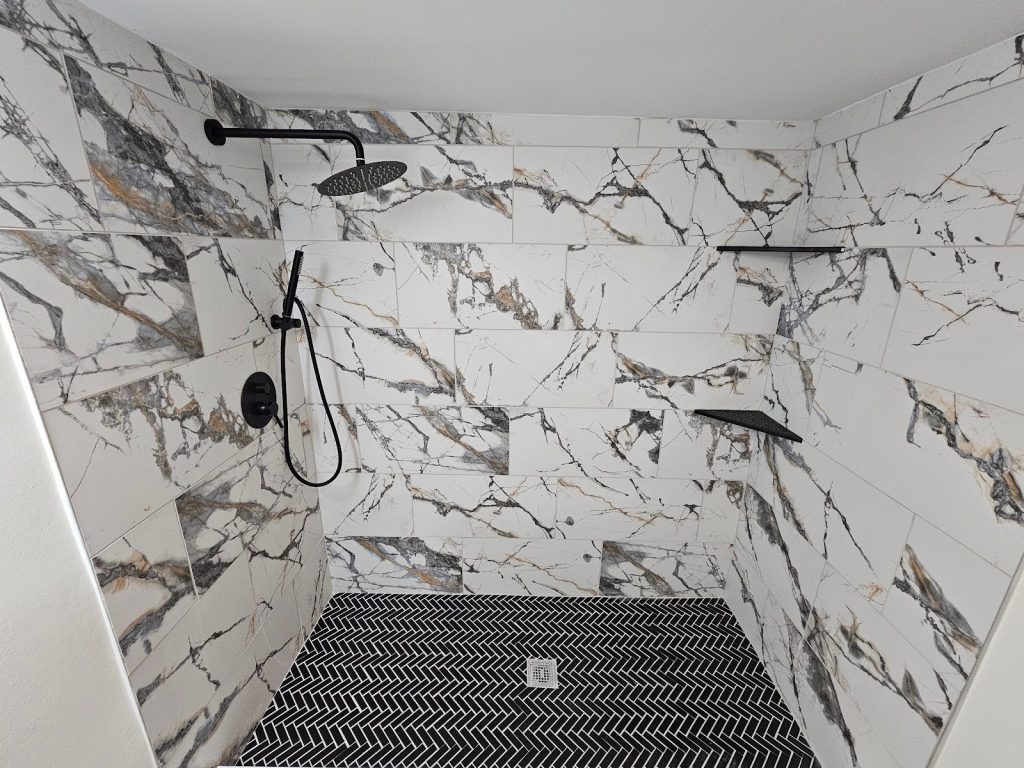
This tile is not natural, it’s a replica, made in ceramic. The glazing has this pattern to replicate a Statuario white marble found in Italy, or a similar aesthetic. The shower head extends with a long arm mounted back to the wall. This type of head and configuration is similar to a ceiling mounted rain shower head. Instead, this is a wall-mounted rain shower head with a matte black or black gun metal finish. While the supporting arm is fixed, the head is slightly articulable to slightly change the direction of the spray pattern.
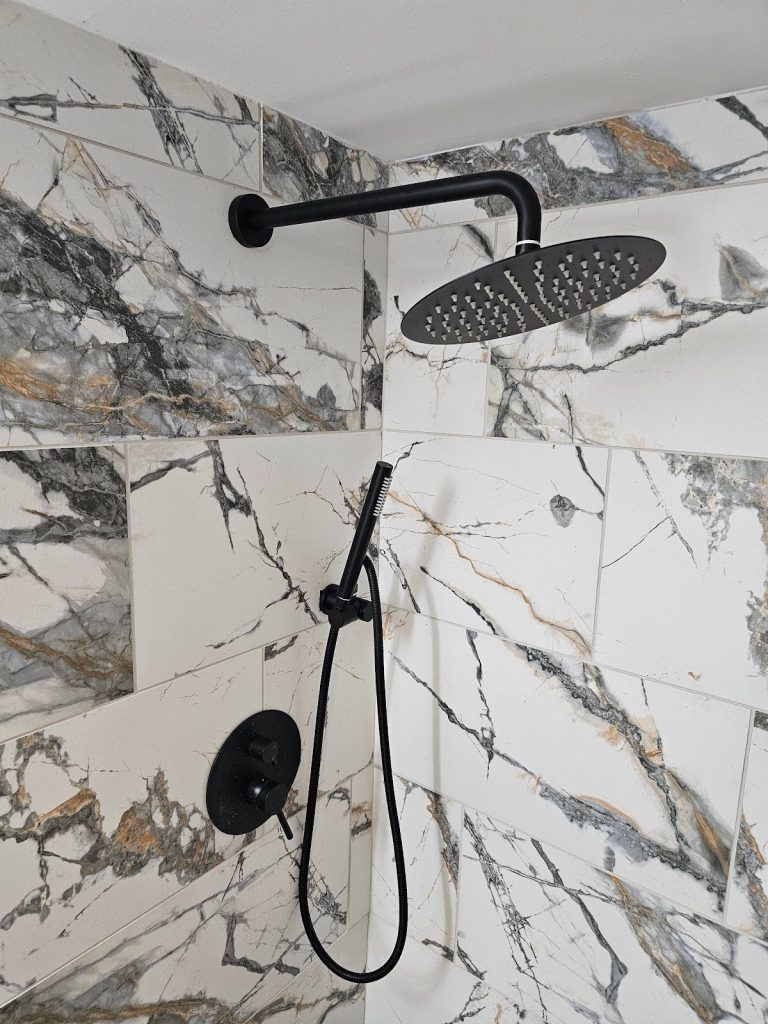
There’s also a wall-mounted shower control that controls both the flow rate of the water and also the temperature. The shower wand can be used to redirect the water into a handheld sprayer. The matte black or gunmetal finish of these fixtures have a modern yet sort of timeless look. They don’t look so modern that they clash with the aesthetic of adjacent elements in a more classic style.
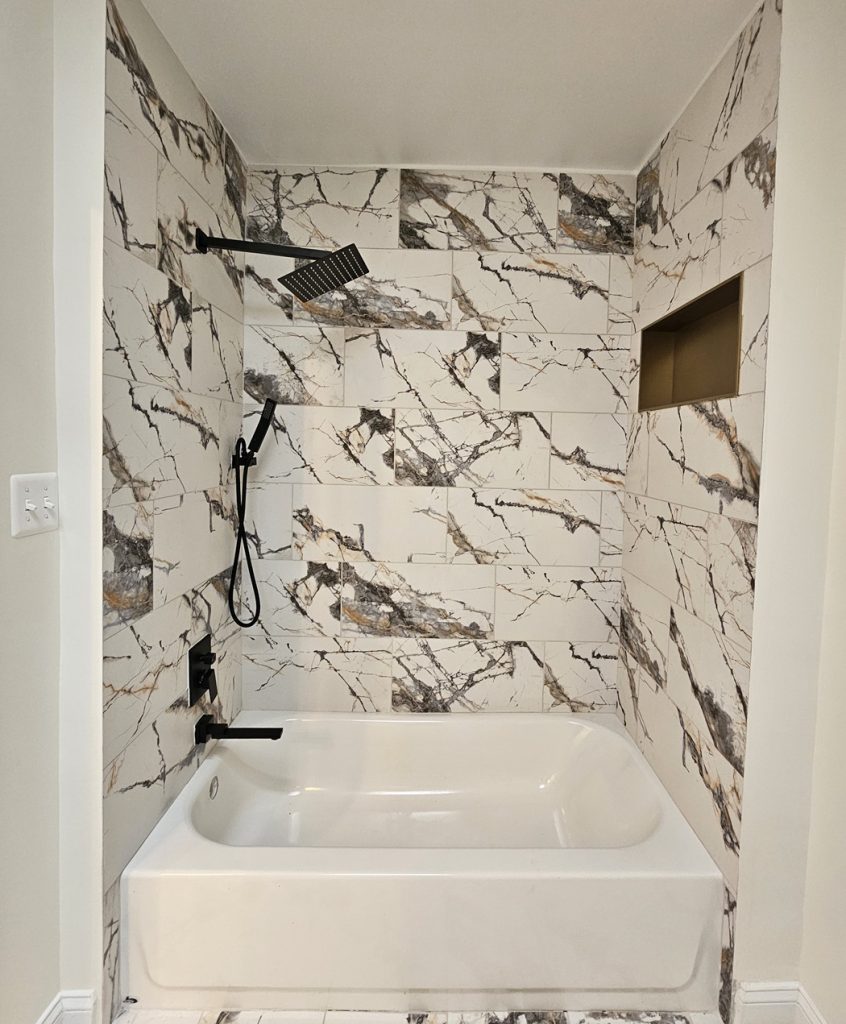
In this upcoming week’s blog we will continue looking at this particular shower installation. Will take a closer look at the floor system which uses a different type of tile. The tile is all black in color yet compliments the adjacent wall tile. We’ll also talk about and look at pictures of corner shelving permanently installed inside of the shower. There are lots of aftermarket types of shower shelving systems but none of them are as good as purpose-built shelving and niches.
Dupont Kitchen & Bath Can Help
As dedicated and local DC metropolitan kitchen and bath builders and installers, we pride ourselves on turning your visions into reality. Your kitchen and bathrooms can reflect your unique style and be designed with personalized aesthetics. It can be a process from creative designs to the realization of your dream space. Specializing in kitchen and bath construction, we bring expertise and skills to every project. If you’re contemplating a renovation, upgrade, or modernization in the local market, we’re happy to be your team. Consult with us, and we can start together on a path to redefine and elevate your DC living experience.
You can visit our company website at https://dupontkitchenbathdc.com/
Here at our website you will find a simple and convenient web form that you can fill to contact us quickly.